What We Leave Out (and Why It Matters)
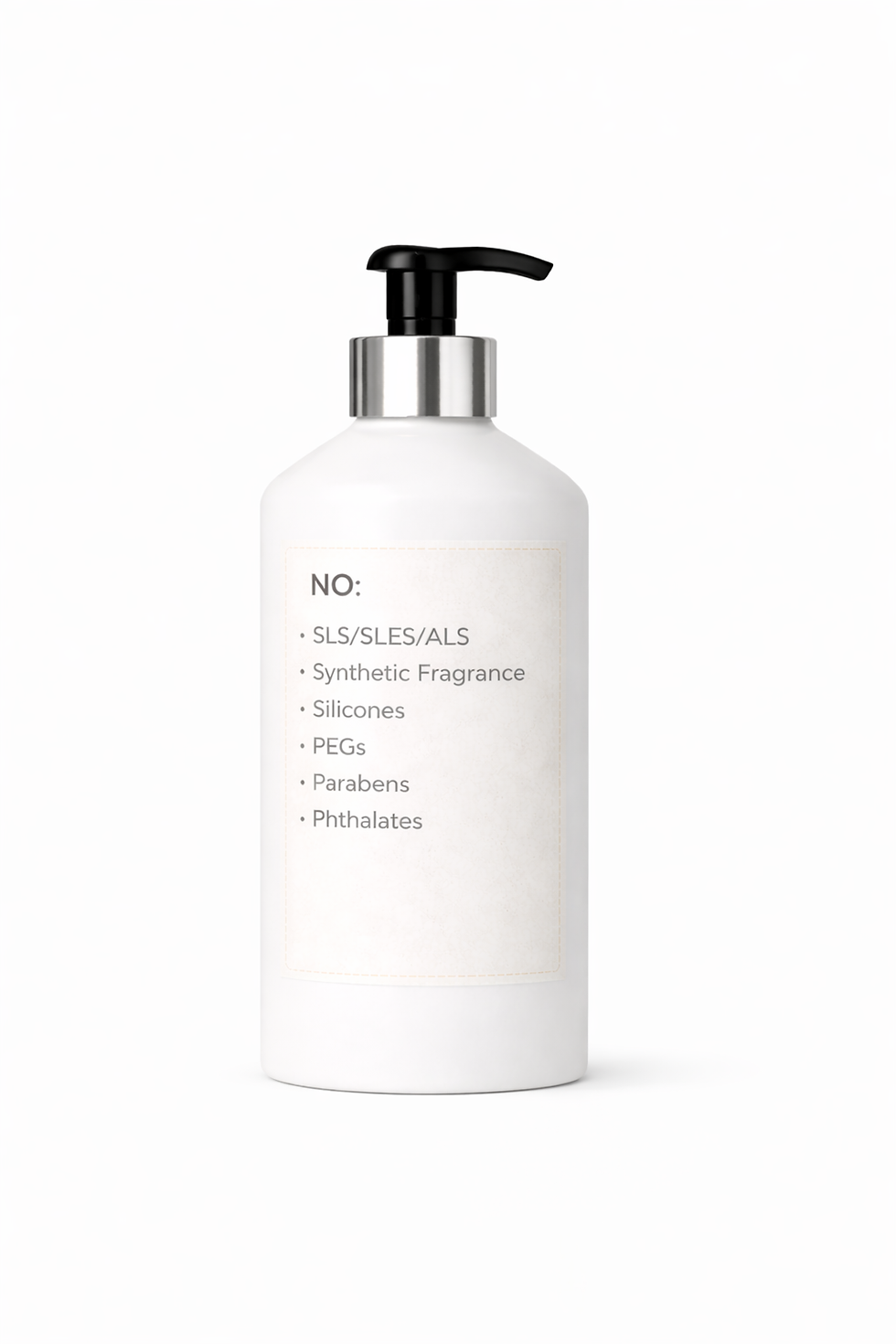
We avoid a whole list of common cosmetic additives because they can disrupt the skin barrier, trigger sensitivity, or work against long-term skin health. Here’s what you’ll never find in MyHealthyRemedies formulas—and why.
- SLS/SLES/ALS
- Synthetic Fragrance
- Silicones
- PEGs
- Parabens
- Phthalates
Why We Say No to SLS / SLES / ALS
While surfactants are necessary for effective cleansing, strong sulfates can compromise the skin's protective layer. We prioritize barrier health by excluding high-foam anionic surfactants known for their research-backed irritant profile and lipid extraction properties.
Barrier Impact
Strong anionic surfactants interact with the stratum corneum lipids and proteins, leading to a temporary impairment of the skin's structure. Research indicates that this disruption facilitates the removal of essential intercellular lipids during the cleansing process.
TEWL & Irritation
The loss of barrier integrity is measured through transepidermal water loss (TEWL). Higher levels of TEWL correlate directly with several physiological markers of skin distress:
- Increased sensitivity to topical substances
- Acute inflammatory response activation
- Compromised regenerative capacity
Scalp Environment
Frequent stripping of the scalp's natural lipids can lead to chronic dryness and perifollicular inflammation. Our exclusion policy supports a healthier follicular environment by avoiding ingredients that extract intercellular lipids and alter corneocyte cohesion, allowing for natural barrier recovery.
Research & Evidence
Findings informed by established dermatological science, including studies published in: Journal of Investigative Dermatology; British Journal of Dermatology; Acta Dermato-Venereologica. All information provided reflects published research and is for educational purposes.
Surfactants & Skin Barrier Function
Anionic surfactants have been shown to:
- Extract intercellular lipids
- Alter corneocyte cohesion
- Increase susceptibility to irritation
Barrier recovery varies between individuals.
Scalp Inflammation & Hair Follicle Health
Emerging research indicates that perifollicular inflammation may be associated with certain patterns of hair shedding.
Maintaining scalp barrier integrity and avoiding excessive stripping may support a healthier follicular environment.
Why We Say No to Silicones
Silicones are hydrophobic polymers derived from silica, valued for their ability to coat the hair shaft to improve slip and shine. While common, our responsibility-led policy prioritises the long-term integrity of the hair fibre over temporary synthetic smoothing.
Cumulative Build-up
Silicones form a non-porous film around the hair fibre. Without regular clarification, this cumulative build-up creates an occlusive layer that can alter natural hair behaviour, masking underlying mechanical damage and hindering moisture balance.
The Adjustment Period
Transitioning away from silicone-heavy formulations temporarily changes the hair feel as the fibre adjusts. This reveal of the true hair texture is a necessary stage towards genuine health, allowing for the natural recovery of fibre resilience.
Key Mechanical Properties
Our exclusion policy prioritises long-term fibre health over the transient smoothing effects of hydrophobic film formation. By understanding the mechanical impact on the hair shaft and considering ecological bio-compatibility, we ensure our botanical formulas support genuine structural integrity.
Research & Evidence
Findings informed by established hair science and cosmetic chemistry. Our formulation narrative prioritises responsibility over ideology, focusing on ingredients that respect the hair’s natural mechanical properties.
Why I Hesitated
Phenoxyethanol is a commonly used preservative in cosmetics. It protects water-based formulas from bacteria and microbial growth — something that is absolutely essential in any safe conditioner.
It is permitted for use in the UK and EU at regulated levels, and is considered safe within those limits.
So this was not about alarm.
It was about intention.
With a long history of eczema and scalp sensitivity, I have always been mindful of cumulative exposure. Some individuals report stinging or irritation with certain preservatives — and while that is not universal, I wanted to explore whether I could formulate without it.
Not because it is “bad”.
But because I prefer to question necessity.
The Silk Question
There is also the question of feel. Silkiness matters. Not the artificial slip that masks the hair, but genuine smoothness that reduces friction and breakage.
If, through testing, avoiding phenoxyethanol compromises safety, stability, or the sensory experience, then I will reassess.
If an ingredient is chosen, it will be chosen deliberately — at the lowest effective concentration — and transparently disclosed. Luxury is not about eliminating ingredients blindly. It is about understanding them.
Formulation is not ideology. It is responsibility.
Why We Say No to SLS / SLES / ALS
Our formulation decisions for surfactants are informed by established dermatological science and absolute responsibility.
Regulatory Note
Made My Own products are cosmetic formulations. They are not intended to diagnose, treat, or prevent medical conditions. All information provided reflects published research and is for educational purposes.
Sodium Lauryl Sulfate (SLS) and its derivatives are ubiquitous in modern hygiene, valued for their foaming efficiency. However, our surfactant policy prioritizes absolute barrier health and lipid integrity, leading us to exclude them entirely in favor of milder, bio-compatible alternatives.
01. Barrier Impact
SLS is widely used in dermatological research as a model irritant because it disrupts the lipid structure of the stratum corneum. This structural alteration weakens the skin’s natural defense mechanism, compromising the moisture barrier.
02. Transepidermal Water Loss (TEWL)
Consistent clinical evidence demonstrates that exposure to strong anionic surfactants significantly increases transepidermal water loss. This leads to immediate dehydration and long-term barrier impairment if used regularly.
03. Irritation & Sensitivity
Strong sulfates are known to trigger inflammatory responses and alter corneocyte cohesion. For those with sensitive scalps or hair thinning, avoiding excessive stripping may support a healthier follicular environment.
04. Study References
- Journal of Investigative Dermatology
- British Journal of Dermatology
- Acta Dermato-Venereologica
The Silk Question
There is also the question of feel. Silkiness matters. Not the artificial slip that masks the hair, but genuine smoothness that reduces friction and breakage.
If, through testing, avoiding phenoxyethanol compromises safety, stability, or the sensory experience, then I will reassess.
If an ingredient is chosen, it will be chosen deliberately — at the lowest effective concentration — and transparently disclosed. Luxury is not about eliminating ingredients blindly. It is about understanding them.
Formulation is not ideology. It is responsibility.
Why We Say No to PEGs
Polyethylene glycols (PEGs) are versatile compounds used across the industry for their emulsifying and thickening properties. While common, our research prioritises barrier integrity and the elimination of manufacturing impurities to ensure long-term skin health.
1. Barrier Permeability
2. Ethics of Purity
Ingredient Index
PEGs can act as "penetration enhancers," increasing the permeability of the stratum corneum. For sensitive or compromised skin barriers, this can allow unintended substances to penetrate deeper into the skin, potentially increasing the risk of irritation.
The ethoxylation manufacturing process used to create PEGs can involve trace amounts of 1,4-dioxane. While modern purification standards are exceptionally high, we choose to mitigate even the theoretical risk by opting for PEG-free, plant-derived alternatives in every formula.
- PEG-100 Stearate
- PEG-40 Hydrogenated Castor Oil
- PEG-8 Caprylic/Capric Glycerides
We acknowledge that PEGs are widely considered safe for topical use, but for a brand built on prioritising skin barrier function and transparency, they do not align with our "Responsibility over Ideology" framework. Every exclusion is a deliberate choice for safety and stability.
Regulatory Note
Made My Own products are cosmetic formulations. They are not intended to diagnose, treat, or prevent medical conditions. All information provided reflects published research and is for educational purposes.
Why We Say No to PEGs
PEGs (polyethylene glycols) are ubiquitous in modern skincare, valued for their ability to blend oil and water. However, our research-led approach prioritizes absolute barrier health and ingredient purity, leading us to exclude them entirely from our research narrative.
Barrier Integrity
PEGs function as penetration enhancers, increasing skin permeability. While this can deliver active ingredients, it may also inadvertently allow unwanted pollutants and irritants to bypass the stratum corneum, compromising the skin's natural defense mechanism.
The Purity Challenge
The manufacturing process of ethoxylated ingredients involves the risk of contamination with byproducts like 1,4-dioxane. By selecting plant-derived, non-ethoxylated alternatives, we eliminate this variable entirely, ensuring a cleaner profile for sensitive scalps.
Environmental Impact
PEGs are synthetic polymers typically derived from petroleum. Our philosophy is rooted in botanical synergy and seasonal awareness; we believe the most effective slip and stability can be achieved through regenerative, nature-identical ingredients.
Ingredient identifiers:
- PEG-100 Stearate
- PEG-40 Hydrogenated Castor Oil
- Ceteareth-20
- Polysorbate-60
Avoiding PEGs is not about alarmism—it is about the intentional pursuit of bio-compatibility. Every ingredient must justify its presence by supporting the skin's long-term health, without structural compromise.
Why We Say No to Synthetic Fragrance
Synthetic fragrances are among the top allergens in modern cosmetics. Our commitment to skin health means choosing transparency and safety over the hidden chemical catch-all of 'parfum'.
Skin Sensitization
Dermatological research identifies synthetic fragrance as a primary trigger for contact dermatitis. We eliminate this variable entirely to protect the skin's natural lipid barrier and support reactive skin types.
Hidden Components
Because fragrance formulations are often protected as trade secrets, thousands of chemicals can be used without disclosure. We prefer the honest, raw, botanical scents of our plant-derived ingredients.
Why We Say No to Parabens
While parabens are efficient preservatives, our research prioritizes modern, plant-derived alternatives that align with our small-batch philosophy and bio-transparency goals.
Systemic Awareness
We follow the precautionary principle regarding cumulative exposure to endocrine-active substances. Our preservation systems are chosen for their minimalist profiles and absolute safety for the skin's long-term health.
Why We Say No to Phthalates
Phthalates, often used as fixatives or hidden within fragrances, find no place in our Wiltshire-crafted formulas. We prioritize endocrine health and botanical purity above all.
Purity over Plasticizers
Skincare shouldn't involve 'persistent' chemicals. By excluding phthalates, we avoid substances that have been linked to developmental and reproductive concerns in established research, ensuring a safer profile for your daily ritual.
A Balanced View
Our ingredient policy is not about alarmism—it is about the intentional pursuit of bio-compatibility. Every exclusion is a deliberate choice for safety and stability. We believe that by removing substances that raise even theoretical concerns for sensitive skin, we can focus on what truly supports long-term epidermal health.